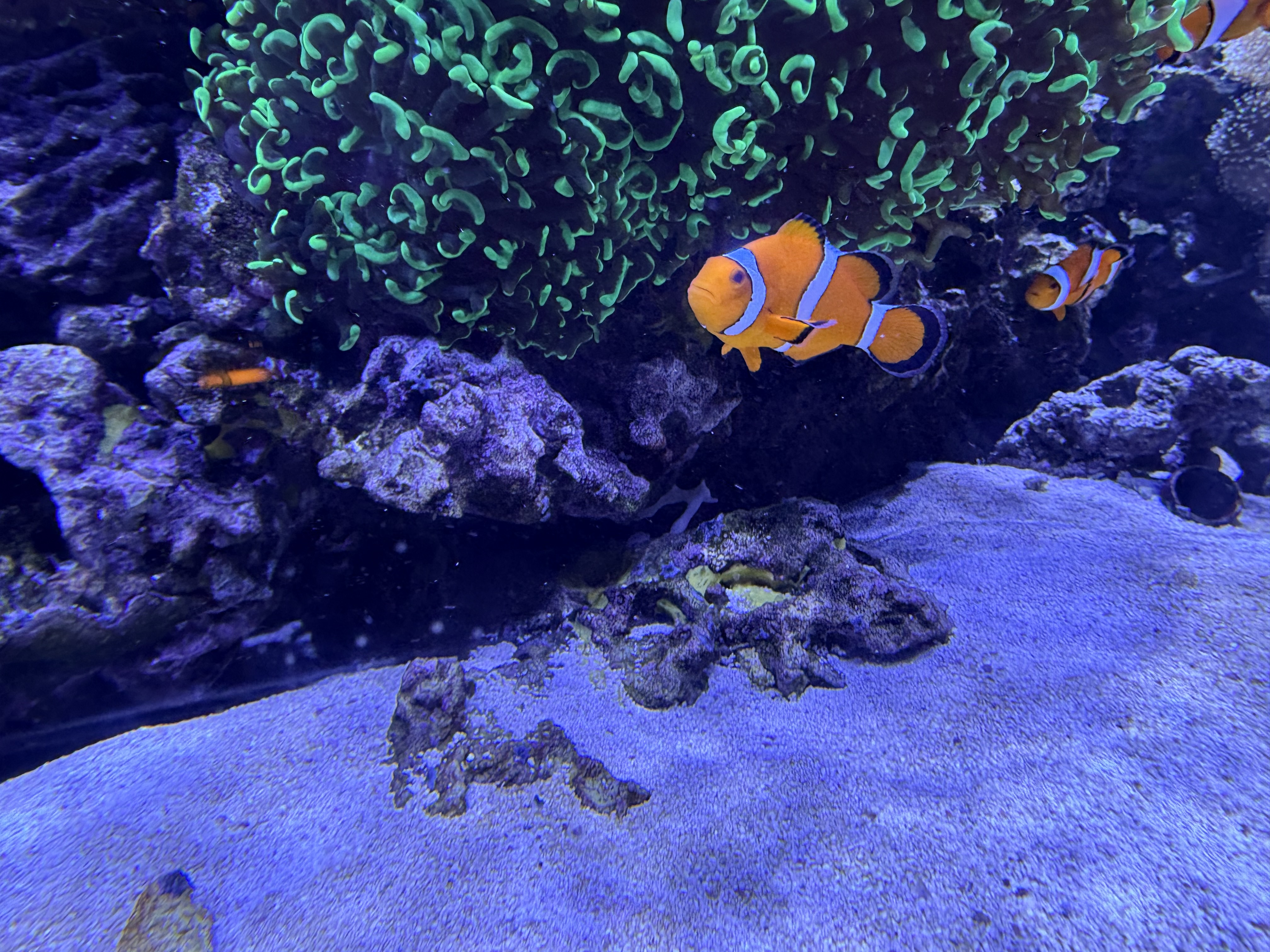
 Nemo was never the only one who was lost.
We have a whole movie about Finding Nemo, and another movie (that I’ve never watched) about Finding Dory. Let’s talk about Finding Marlin.
Marlin is very one-dimensional. We meet him as a generic, overprotective dad. It feels like that’s all he knows how to be, all he can be.
It’s Marlin. Nemo’s dad is named Marlin.
It’s easy to miss; of course a dad is going to be protective of his child, of course the ocean is dangerous, of course dad is going to want to find his lost son. That’s all you need to set up a movie.
What gets glossed over is that Marlin used to be a complete person (well, fish, but I’m writing this in human terms). The indescribably massive trauma of losing his wife and all of his other children has collapsed him entirely; he no longer exists as an individual. He exists within his job, his purpose. He is only a protector.
It’s important to note here that this can happen to anyone, and it doesn’t require a barracuda consuming your entire family to make it happen. Retreat into one-dimensionality is a form of self-erasure, and many things can cause that - general insecurity, stress, or even just a bad day can make someone want to hide from themselves… and nobody is going to question you losing yourself in pursuit of something reasonable.
The discussion here isn’t about identifying or preventing the cause - in fact, Marlin never shows any hate or ill-will towards the barracuda that ate his family. There is no revenge arc, because the trauma is not the problem.
The problem is the quiet acceptance of what Marlin’s existence is, now, because to him that is all he can be. All of the threats in the ocean are now perceived as barracudas; there is no room for anything else.
Marlin’s position that Nemo must be protected above all else is a completely reasonable stance. He has lost everyone else. He has lost himself. Nemo must persist. What’s interesting is that this is not a new worry. Every dad wants to protect their kid. Marlin’s trauma and self-erasure didn’t invent the worrier, it removed every other register. All that’s left - all he can be - is a sentry, a risk assessor, a narrator of disaster.
He no longer knows how to be a friend or a neighbor. He’s a clownfish who doesn’t know how to be funny.
Being Nemo
-
If Dad is only safety, the child becomes only danger.
-
If Nemo is loved as a problem to manage, Nemo is not loved as a person to know.
-
There is no play, there is no trust, there is only active (or potential) crisis.
-
Love with nowhere to live except on top of the child’s head … feels like being owned.
- It’s not that Marlin loved Nemo too much, it’s that there was only one place to put it.
-
Nemo has to invent himself against Marlin instead of beside him.
- Marlin cannot see Nemo accurately- Marlin completely misses the competence, humor, and leadership Nemo demonstrates in the tank because he is so focused on protection.
A child cannot have a relationship with a parent with no remaining self. There’s nothing for Nemo to interact with except the rules, which is exactly what he does.
The overprotection manifests the crisis it fears; Nemo touches the boat not as an act of random rebellion, but as proof of competence against a parent who had already decided he couldn’t.
Finding Marlin
(The title-as-a-subtitle)
Marlin crossed into the big blue as someone collapsed into a single function, and came back as a person - only slightly, but the biggest steps are often small. He never lost his worry, but he did restore a few other human frequencies that he had muted… exactly the ones Nemo needed.
Along his journey he learned that he can be a friend, he can be wrong without dying, he can be funny, that the ocean can be astonishingly beautiful not just a threat, and he learns that he does not need to be the only actor. Nemo never needed a better security system. He needed a father with more than one note.
Finding Nemo required Marlin to become visible to himself, at least a little.
Love without a sense of self is hard to receive. We see this early on when Dory meets Marlin, he simply cannot accept her presence. As Marlin is found he is able to accept her better. We see it in Nemo, too - as Nemo finds himself, he is able to see just how much dad loves him.
Marlin did not find himself on the main quest to find Nemo. He found himself in the distractions and side quests, the things he thought were detracting from the real goal. He thought the whale, the current, and the forgetful stranger were delays. They were the places he was out-of-place enough to learn about himself. The inefficiencies that bothered him so much proved that he can still be acted upon by the world; being a part of the world, not just be a shield against it.
It’s the distractions and the frustrations that create the next version of us, shielding ourselves from them limits growth.
Dory is a pretty big distraction.
Congrats, you’ve made it to the important part of the article.
Dory is instrumental in Marlin finding himself and finding Nemo. Exactly how she goes about helping is absolutely beautiful.
As they let go and fall into the whale-
“How do you know something bad isn’t going to happen?”
“I don’t!”
Love wants a guarantee. Life does not give one.
The ocean is dangerous; Marlin is not crazy. But Dory cannot live in Marlin’s horrendously bad past or in his projected future catastrophe. Dory can only be present, she can only be a companion in the current moment.
That is the exact opposite of, and exactly what’s missing from, Marlin’s entire approach to life - anticipate, control, and narrate the disaster in advance. Dory’s “Just keep swimming” is the only option because the past and the future are equally unknown. She is simply present.
Marlin has a plan: control the ocean. Dory is the person who will remain with him when that plan inevitably fails.
Dory sees Marlin. Dory never sees his panic as the definition of what he is, she sees the person underneath the panic. You don’t fix a Marlin. You simply be present and outlast the version of him who thinks he’s only a single function.
That’s what Marlin needs. He needs someone who remembers he is a person - and forgets everything else - and will still be there when the fear is done talking.
Being Dory
I suppose it’s easy for Dory to be all of that because she has the memory of a fish. Sometimes the most loving thing someone can do is not remember your worst day the same way you do.
But maybe we can figure out some ways to be more like Dory, and maybe that can even help ourselves when we’re feeling a bit like Marlin. Simple presence is not a strategy - and that’s exactly why it works when strategies fail.
-
Sit in the current. Be present, don’t try to stop it, don’t try to exit it, acknowledge what’s going on. Don’t argue him out of the fear; it’s real.
-
Remember the person, not the weather. Today’s terror is the weather, it will pass, the person persists.
-
Let them recover a note that isn’t fear. Laugh if a laugh appears, regardless of situation. Notice and point out when they are brave, beautiful, or thoughtful.
-
Stay for the boring parts. The worst parts are rare, but if you’ve been there for the boring bits, Marlin will know you’ll be there for the bad stuff.
What’s all that do?
It proves that love can exist without a safety guarantee. It gives them a relationship that is not solely focused on preventing death. It enables them to find themselves a bit and perhaps let go a little, because they will not be alone if they decide to have a bit less fear.
You can’t promise anyone that nothing will happen. You can only promise that you won’t vanish while it does.